For My New Photo Gallery Click Here
More Photos In This Series

Tuesday, 9 November 2010

Sleeping Beauty--White-rumped Munia

The White-rumped Munia is a small bird (about 11cm in length) and a resident breeding bird in tropical southern Asia including Hong Kong. 

From their appearance we can see that they are related to the finch family. 
 
They feed mainly on seeds.
 
The White-rumped Munias are often seen feeding in woodlands and urban parks. A few days ago, I was lucky to see a sleeping White-rumped Munia in my local park. I have seen birds sleeping on trees but this was the first time that I encountered a bird sleeping on the ground.

The bed was some dry leaves under the shade of grass. 

I managed to stay a few meters away without waking it up. 

 
After a few minutes, the bird must have sensed my presence. 

I guess it might be very tired because the bird gave me a sleepy look and went straight back to sleep. I was so pleased to have been able to capture this sleeping beauty. 


In fact, this one was not the only bird who didn’t mind me being around. One bird looked straight into my camera. 

Another one even posed for this portrait.

I was so impressed with their feathers which looked like a big shawl on their shoulders.  

 
Another common bird in South Asia, the Scaly-breasted Munia, looks very similar to the White-rumped Munia, except its underparts are white with black scale markings. 


Saturday, 30 October 2010

Witness to a murder

The weather has been very pleasant recently so I decided to take a walk up the hill at the back of my village. There I saw a big fat caterpillar happily feeding on a small tree.

Suddenly, two wasps were flying over to the tree. Within seconds, they started attacking the caterpillar, the head first and then the tail. 


The stings must have been really painful but the caterpillar was fighting very hard by shaking its head violently. 


The conflict  lasted for a couple of minutes and eventually the wasps gave up and flew away. The poor caterpillar was in agony but it didn’t look as though it was very badly injured.  

I was relieved for the caterpillar and thought it was its lucky day.

 
As I was about to leave the caterpillar to recover from its ordeal, suddenly, a huge hornet flew straight over. Before I even held my camera up, the caterpillar was in pieces! 


The hornet was so vicious that within seconds, the caterpillar’s insides were all over the place.


The hornet must have been very hungry and before I knew it, most of the caterpillar flesh was gone.


Then the hornet carefully folded up some of the remaining flesh and flew away with it. 


This was all left of the once big fat caterpillar. 

I guess there must be a hornets’ nest nearby. I thought about looking for it for a second but I remembered that I have read  somewhere that if under threat, hornets can mobilize the entire nest to sting. I left immediately.

Friday, 22 October 2010

A Beautiful Common Kingfisher

The hot and humid summer has finally gone. We will be seeing more and more birds in Hong Kong from now on as the winter migratory birds from Northern China begin arriving. 

   A couple of days ago,  I went out to a nature park and spotted a Common Kingfisher fishing on a pond. I haven’t  seen any kingfishers the whole summer and I was so pleased to see one at last. 

Usually the kingfishers are very shy and always keep their distance from people, but this one was probably too preoccupied to take any notice of me. I couldn’t believe my luck as I was able to get some close shots of this beautiful bird.


Saturday, 16 October 2010

Colourful Birds

I have talked a lot about birds in my neighbourhood, today I will introduce to you some of the colourful birds in Hong Kong.  

My favourite one is the beautiful Silver-Eared Mesia . It is a medium sized bird (body length:16-18cm; weight: 15g). It can be seen in Hong Kong in Autumn and Winter.  Unlike most birds, the Silver-eared Mesia prefers fruit such as berries to worms.


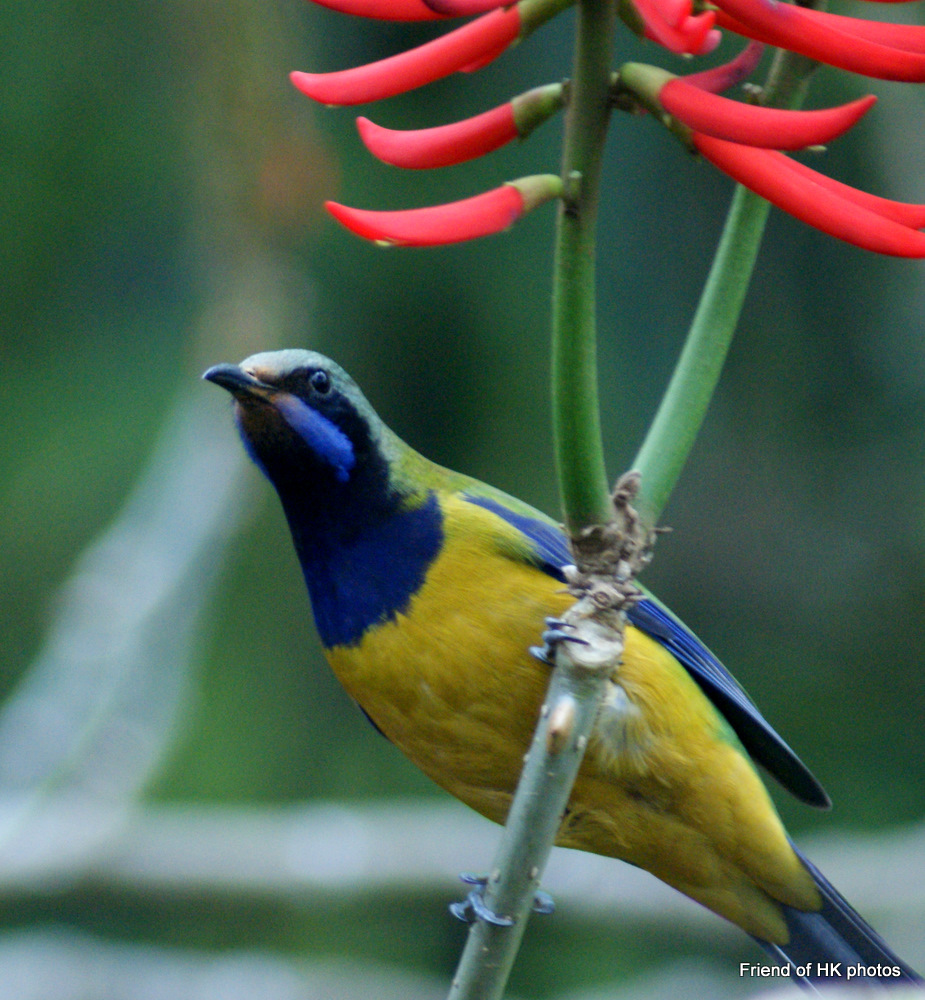
The Orange-Bellied Leafbird is another one of my favourites. They are slightly bigger than the Silver-eared Mesia and like to feed on nectar as well as insects and fruit.
 
Both sexes have an orange coloured belly but the male (top 3) is much more colourful than the female (bottom 2).


The tiny Fork-tailed Sunbird (9 cm long) is a common bird seen not only in woodlands but also in urban parks.
 
Like the Orange-Bellied Leafbird, the Fork-tailed Sunbird also shows dimorphism, with the male being much more colourful than the female. You can see from their delicate beaks that they are nectar eaters and are often seen looking for food among flowers. This is a male feeding on a Coral tree.


This is a female visiting my garden a few weeks ago.